Micheal G. Kelly, Ian Hart, John
J O`Connor
Journal of the Irish Medical Association, April 30, 1979, Volume
72, No.4
Our purpose in this article is
to throw light on the extent to which Dublin drug abusers belong
to distinct social and demographic groups. Specifically, we are
interested in ascertaining the personal and social correlates
of opioid(1) use and in providing a profile of seriously
at-risk groups.
The study builds on that of Kelly
and Sammon (1975) which describes the characteristics of a group
of abusers considered as a whole. Like that study, this is confined
to clients of the Jervis Street Drug Advisory and Treatment Centre,
a free clinic attached to a large Dublin hospital. Likewise, much
of this report is based on the clients' account of themselves,
an account which may not always be reliable.
Clients of the Centre are referred
b a variety of statutory and voluntary agencies and are also self
referred. It is reasonable to assume that all have a problem of
some kind connected with drugs, whether physical, as in the case
of an abscess arising from a dirty needle, legal, as in the case
of prosecution for possession, vocational, as in drug-induced
difficulties in the course of employment or study, or social,
as in the case of rejection by family or friends because of drug
use. Some come without external pressure because they fear they
are in danger of becoming addicted, with adverse consequences
for their lives in general. We use the term "abuser" rather than
"user" in view of such associated problems rather than because
of the unprescribed nature of most of the drug taking.(2)
Incompleteness of data was a problem
we frequently encountered in examination of the files. This was
often due to the very superficial nature of the contact which
sometimes consisted of no more than a telephone call. Faced with
the problem of scanty information in many cases, we have chosen
to work with a small number of cases with complete information
rather than a large number with some information missing. Our
sample is accordingly not a complete one and the possibility must
be noted that some of the cases excluded because of inadequate
data represent a less addicted (because less recorded) group than
those included. Also excluded were some few clients with an alcohol
problem only.
A cursory examination of the files
suggested that opioid use characterized a group more deprived
and delinquent than the others. However, only small groups, with
one exception, seemed to have confined themselves to a single
drug or type of drug such as the opioids. Many were poly-abusers
and took three or more drugs. The exception was a fairly large
group who had taken cannabis only. An associated group were those
who showed a marked preference for cannabis which they frequently
supplemented with L.S.D. Another impression from the files was
of a small group of barbiturate takers characterized by serious
personal and social problems. We used these impressions to form
the bases for our analyses.
Our findings relate to the Dublin
and Dun Laoire Urban Boroughs as the great majority of the Centre's
clients, over 90%, were born in those areas.
Methodolgy To establish correlates
of opioid use a survey was made of the subjects of Kelly and Sammon's
study, assigning these to opioid and non-opioid groups. This sample
numbers 537, being 2(3) less than their sample. It
consists of clients who between October '71 and December '73 completed
a standard questionnaire on basic demographic factors, personal
history, family background and drug history. Since the results
of this survey did not throw much light on the development of
opioid abuse, it was decided to supplement it with a survey of
all clients from the Centre's opening in October '69 to mid-August
'77 for whom
appropriate information had been
recorded and who were abusers in the sense of having more than
an alcohol problem. This second sample numbers 1,175. The first
sample was assessed for 12 variables, the second for 15 variables.
These two surveys constitute the first part of the analysis. Part
2 involves a more detailed stuffy of clients between mid-October
'73 and mid-August '77 and examines differences between 6 types
of abuse. Because of inadequate information, only 169 out of 563
clients were assessed in this part of the study. Since more than
half the subjects assessed were rated as abusing drugs on a daily
or almost daily basis, there is a strong possibility that those
excluded from consideration included a high proportion of less
addicted clients.
Chi-squared tests are used to assess
the chance probability of differences arising between proportions
in groups with specified characteristics and differences with
a probability of occurring at 5% or less are regarded as significant.
In Part 2, cluster analysis is used to identify naturally occurring
groups with a view to comparing such groups with those based on
type of abuse. This cluster analysis, which involves the use of
an algorithm from the CLUSTAN computer programme, provided a number
of clusters and from which the most meaningful clustering was
selected by inspection of cluster characteristics.
Part 1: Of 537 subjects in the first sample,
some 181, or about one-third, had taken an opioid other than in
a cough mixture at some point in their drug history. Opioids which
had been used were-heroin (20%), morphine (19%), Diconal (9%),
opium (6%), Palfium (5%) and pethidine (2%). Characteristics of
the overall sample have already been described by Kelly and Sammon
(op.cit) who note the predominance of males (79%), the high incidence
of Court appearances (33% prior to the onset of drug taking),
the over-representation of semi-skilled manual workers (22%) and
the very high level of unemployment (55%). Our results for the
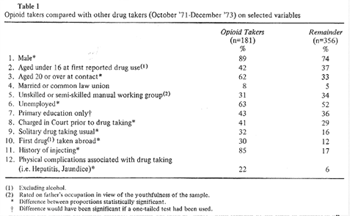
comparison of opioid abusers with others are given in Table 1.
Since there is little difference between reported age at first
drug use, the opioid takers would seem to have been involved with
drugs for a longer period before referral to the Centre. Their
higher rate of unemployment may reflect a more lengthy involvement
with drugs although their higher delinquency rate prior to drug-taking
suggests background differences not attributable to drug taking.
Supportive of the impression of prior background differences in
terms of social deprivation or opioid before any other drug. In
Part 2, we compare opioid takers and non-takers with period of
drug use held constant.
The greater delinquency of the
opioid abusers prior to the onset of drug taking was accompanied
by a similar difference in respect of delinquency after drug taking:
23% of opioid takers as against 10% of the others were in Court
after the start of drug taking on such charges as larceny and
breaking and entry, and 30%, as against 7%, had been charged with
illegal
possession of a drug. Their high
delinquency rates resemble those reported by other researchers
such as James (1969), Willis (1971), and Mott and Taylor (1974)(4).
Both opioid takers and others showed a preference for cannabis
or L.S.D. as first or second drug but one-sixth of the opioid
takers started on an opioid and about the same proportion took
an opioid as second drug. Although some differences emerged between
the groups, which show opioid takers as more delinquent or disadvantaged
and are related to the mode of administration of the drug, the
results do not indicate radical psychosocial differences. In the
second comparison of opioid takers and others, we assessed personal
and domestic circumstances more closely.
The 1,175 members of the second
sample represent 78% of all clients up to mid-August '77. In 11%
of cases only the barest details of age and sex had been recorded
and in a further 11% of cases the drug problem was confined to
alcohol or not enough information had been recorded to warrant
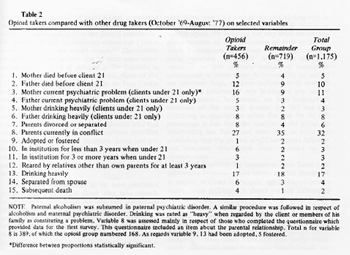
assignment to an opioid or non-opioid group. Table 2 compares
the two groups, 456 opioid takers (39%) and 719 other abusers,
on 15 selected variables.
The only difference attaining
significance is that relating to maternal psychiatric disorder,
which is highly significant (p<001). Most of these disorders were
described as 'nerves' or depression and in the great majority
of cases the mother was on psychoactive medication. In one-third
of these cases the mother was clearly under family stress such
as that arising from alcoholic or psychiatrically disturbed husband.
Apart from this difference, the table shows up the kind of personal
and family problems associated with drug abuse in Dublin. The
alcoholism of parents (11%) and the clients' own alcoholism (17%)
seems a specifically Irish dimension of drug abuse. In respect
of parental loss during childhood or youth(5) and in
level of institutional experience the overall sample seems more
handicapped than would have been expected for the general population.
The proportion with institutional experience (3%) is about double
what one would expect.(6) The number adopted as children
is low, the 11 such cases representing only 0.15% of all children
in the Republic in the period '53 through '61. In contract, those
of the 1,175 drug abusers born in Dublin or Dun Laoire during
that period (about 57%) represent 0.59% of the total of 118,066
births indicated by the '56 and '61 Census Reports for Dublin
and Dun Loire. Thus, adopted children would seem somewhat less
at risk than others, although some of the abusers who had been
adopted seemed to have encountered problems specifically related
to their adoption. Some had not been adopted until over a year,
some had not been told about their adoption when they should have
been and some were effectively only children or only adopted children.
Part 2 : Our comparisons so far
have combined regular opioid takers with those who take opioids
less frequently. Moreover, we did not distinguish subgroups within
the non-opioid group. In order to remedy these defects we examined
the records of 563 referrals to the Centre between October '73
and mid-August '77 approximately with a view to establishing the
characteristics of the following groups at initial contact with
the Centre:-
-
those
who had taken minor tranquillisers such as valium or Librium
only;
-
those
who had taken barbiturates only or barbiturates and tranquillisers'
-
those
who had taken opioids only or mainly;
-
those
who had taken cannabis and/or L.S.D. only;
-
those
who had taken at least two drugs, excluding the opioids, or
at least on drug, a non-opioid, in addition to cannabis and
L.S.D.;
-
those
whose drug use was similar to those in Group
-
except
that they took an opioid at some stage.
These groups formed, respectively,
5%, 2%, 4%, 21%, 23%, and 36% of the 563 cases reviewed. The remaining
9%, who were excluded from the analysis, were those who took a
single non-opioid drug such as an anti-depressant, amphetamine,
cough bottle or volatile agent. We included the very small barbiturate
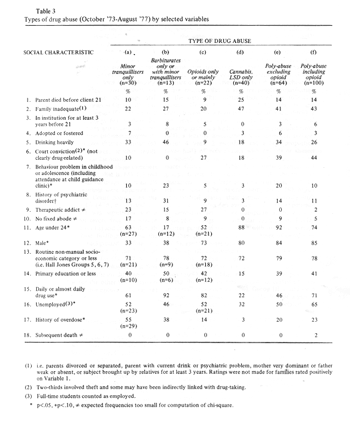
group because of the seriousness of their problems. Table 3 compares
the groups for 18 personal and social variables. As already noted,
this survey is restricted to 269 referrals because of inadequate
information in many cases. As Groups (d), (e) and (f) are relatively
large, we have excluded from them all cases where information
was lacking on any one of the 18 variables. In contract, we have
included all members of the smaller groups, (a), (b) and (c),
indicating as appropriate where the base for the cell percentage
is less than the number in the group. In interpreting the Table
one must bear in mind the possibility that the picture would look
quite different had adequate information been obtained on all
relevant cases.
Table 3 confirms the impression
form Table 1 of differences between opioid takers and the remainder
in respect of Court appearance, age and employment status. More
strikingly, it shows marked differences between subgroups of non-opioid
drug takers. Groups (a) and (b) are predominantly female, groups
(c), (d), (e) and (f) predominantly male. The broad trend from
(a) to (f) is from personal inadequacy to cultural deviance, as
is evident from the patterns in therapeutic addiction, Court conviction
and family inadequacy. Group (a), apart from being largely female,
are a young group with a marked history of overdosing and a high
level of therapeutic addiction. They have the highest incidence
of homelessness. Group (b), the small group of barbiturate takers,
also tend to be female but are significantly older than the first
group. They exceed all in the incidence of drug and alcohol consumption
and psychiatric disorder. Because of their greater age and absence
of Court conviction, they seem the least subculturally deviant
group. They have the highest incident of youthful behaviour disorder
and the second highest incidence of overdosing. Group (c), the
opioid takers, are second oldest after Group (b) and a predominantly
male group. Although they have the second highest intake of drugs,
they have a low incidence of overdosing, which suggests a stable,
non-suicidal pattern of drug use. They have the highest incidence
of therapeutic addiction but the lowest consumption of alcohol,
a result perhaps linked with the heavy use of opioids. Instances
of family disruption and inadequacy are not frequent in the group
which in these respects resembles Groups (a) and (b), rather than
(d), (e) and (f). Group (d), the cannabis/L.S.D. users, are also
predominantly male and have a low intake of alcohol. These are
a very young group of relatively high educational standing and
with a low level of unemployment in the context of the overall
sample. In respect of Court conviction, the group comes
Between the female groups and the
male subcultural groups, (e) and (f). The cannabis/L.S.D. takers
are more disadvantaged than any other groups in terms of family
disruption and inadequacy but this disadvantage is neutralized
to some extent by educational level and the comparative absence
of unemployment. Group (e), the non-opioid poly-abusers, are the
youngest of all. They have a high level of criminality and youthful
behaviour disorder, and include no therapeutic addicts. Consumption
of drugs and alcohol is considerably higher than in Group (d),
as is the level of unemployment. Group (f), the opioid poly-abusers,
are older than (d) or (e), contain the largest proportion of males
of any group and have the highest levels of Court conviction and
unemployment. Drug consumption is well above that for Group (e)
but alcohol consumption is lower, another result indicating a
substitutive function for opioids.
When the analysis was confine to
those members of the larger subcultural groups, that is, (d),
(e) and (f) of Table 3, who had been on drugs less than 2 1/2
years, two significant differences were apparent. In respect of
non-drug related Court convictions the difference between Group
(f) (47%, n=17) and the other groups (16%, n=38) was significant
and a similar pattern obtained for severe drug dependence (76%
for (f) as against 29% for (d) and (e)). Although the numbers
are small, these findings confirm the impression of important
background differences, further confirmation being offered by
the levels of conviction prior to abuse (41% for (f), 10% for
(e) and 6% for (c)). Incidence of unemployment at first contact
did not produce a significant difference but the trend resembles
that for the other two variables, Group (d) containing 22% unemployed,
Group (e) 30%, and Group (f) 47%).
In order to ascertain if the distinctions based on type
of abuse would re-appear in the course of empirical analysis,
Ward's method of cluster analysis (Ward, 1963) was applied to
what may be regarded as the subcultural groups of that Table-i.e.
Groups (c), (d), (e) and (f). Ward's method, which is one of the
algorithms contained in the Clustan IB suite of Cluster analysis
computer programmes (Wishart, 1969), makes use of the variance
within clusters as the criterion of cluster formation. At each
step in the analysis, union of every possible pair of clusters
(initially, individual subjects) is considered and the two clusters
whose combination results in the minimum increase of the error
sum of squares are united.(7) Groups (a) and (b) were omitted
from this analysis because of inadequate information on the educational
and social variables. Two cluster analyses were made. The first
involved all the variables of Table 3 with the exception of variables
3,4 and 18, for which the rate of incidence was very low, and
with the addition of the variables, type of abuse(8) and period
of involvement. Sample size was 202, a number of cases being excluded
because information was lacking on period of involvement. The
programme was instructed to find solutions, ranging from 12 through
3 clusters. Inspection of the characteristics of the emerging
clusters led to the choice of a five cluster solution as a meaningful
organization of the data. This solution indicated the following
groups: Group I, consisting of 99 subjects, and characterized
by a high percentage of males (96%), a low level of occupational
stats (mainly manual working group), a high level of unemployment
(over half), a lengthy involvement with drugs (on average, about
4 years 2 months), and a high proportion (over half) of poly-abusers
with opioids or abusers of opioids only or mainly. Group I, thus,
approximates Group (f) or Table 3, a deprived subcultural group.
Group II, consisting of 50 subjects, and characterized by a large
proportion of females (46%), relative youth (the majority being
under 19), higher occupational status than Group I, relatively
high educational status (on average with some experience of secondary
school), consumption in the main of non-opioid drugs, in particular
cannabis or L.S.D., shorter period of involvement with drugs (on
average less than 3 years) and a low incidence of overdosing (10%),
approximates Group (d). Group III, consisting of 40 subjects,
was characterized by a high incidence of disrupted families (60%),
a high level of non-drug related Court convictions (50%), and
a high level of behavioural problems during childhood or youth
(40%, as compared with an over al incidence of 12 %).
Group III would seem to arise from
families suffering the loss of a parent during the subject's early
years, with associated lack of cohesiveness among the remaining
members and acting-out by the particular subject. It bears some
resemblance to (e) of Table 3. Group IV, consisting of only 9
subjects, contained significantly high proportions of people with
no fixed abode (100%) and psychiatric disorder (67%). It had the
lowest average occupational status of all 5 groups. This was clearly
an extremely deprived psychiatric group.
Alcohol consumption was highest
of all groups (56% drinking heavily) and most of its members were
in the poly-abuse without opioids category. Group V, a tiny all
male splinter group of only 4 subjects contained all the therapeutic
addicts in the entire sample. Three of its four members were psychiatrically
disturbed and all four were unemployed. It was the oldest and
most drug dependent and opioid dependent of all groups. The latter
tow groups emerged at a very early stage in the analysis, representing
clusters 5 and 12 of the 12 cluster solution. In contrast, Group
II first appeared at the 7 cluster and Group I at the 6 cluster
stage.
All the above groups reappeared
in a second cluster analysis in which three variables, type of
abuse, age and education, were given a double weighting to allow
for their special classificatory significance. The five cluster
solution in this analysis resembled that of the unweighted analysis.
The cluster analyses, therefore, tend to confirm in general the
significance of the distinctions based on type of abuse for the
subcultual groups of Table 3.
Of 45 comparisons in Tables 1,2 and 3, 16 produced significant
differences and 2 differences significant at the .10 level. It
seems that as elsewhere there are important social background
differences between opioid takers and non-takers in Dublin, opioid
takers being generally more disadvantaged. However, among opioid
takers those who confine themselves almost entirely to opioids
are an older groups with a higher incidence of therapeutic addiction
and a lower incidence of familial inadequacy than the others.
They represent no more than about 4% of the Centre's intake, the
largest single group of which comprises other opioid takers who
are poly-abusers and who constitute about 36% of intake. Among
non-opioid takers the cannabis/L.S.D. users were distinguished
by personal and social background from groups on minor tranquillisers
and/or barbiturates. They would seem to constitute a subculture
of hedonic experimentation associated with faulty family relationships.
What these distinctions indicate is that the choice of drug represents
a complex interaction of personal need, peer group circumstances
and type of drug available. The theory of escalation of drug use
from cannabis to narcotics has to grapple with the consideration.
Cannabis was the most common first drug used in the first sample
of Part I, but some did not progress beyond it, some took other
drugs excluding opioids and some actually did progress to opioids.
There were also those, about one-sixth of all opioid takers, who
started on an opioid, those young women who developed a habit
on minor tranquillisers, possibly with the cooperation of complacent
G.P.s, and those older women who graduated from tranquillisers
to barbiturates.
The abuse categories most at risk
would seem to be, firstly, barbiturate takers (about 2%), secondly,
chronic opioid takers (about 4%), thirdly, poly-abusers who take
opioids (about 36%) and fourthly, the minor tranquillisers group
(about 5%). The wide diversity of human need associated with those
groups may be too much for a single clinic to handle. There is
also the consideration that some of those in the cannabis/L.S.D.
category may be influenced by other abusers towards the opioids.
Some degree of specialization with a particular group would seem
to be indicated. This recommendation would seem to be relevant
for a number of drug dependency clinics involved in counselling
or social work in addition to a maintenance programme. Their clients,
like those of the Dublin clinic, are frequently indistinguishable
from members of a delinquent subculture.
Significant differences were found between opioid takers and non-takers
among referrals to Jervis Street Drug Advisory and Treatment Centre,
Dublin, for the following variables: Sex, Age, Employment Status,
Prior Court Appearance, Solitary drug taking, First drug taken
abroad, Injection history, Physical complications associated with
drug taking, and Maternal psychiatric status (for further aged
under 21).
Further analysis indicated 6 types
of abuse associated with particular personal and social circumstances:
(1) Minor tranquillisers, (2) Barbiturates only or with minor
tranquillisers, (3) Opioids only or mainly, (4) Cannabis and/
or L.S.D. only, (5) Poly-abuse excluding opioids, and (6) Poly-abuse
including opioids.
In broad social terms, these 6
groups may be seen as representing psychiatric or personal inadequacy
- groups (1), (2) and (3), subcultural deviance - (5) and (6),
and subcultural hedonism in the context of poor family relationships
- (4). Groups most at risk were considered to be in the following
order - (2), (3), (6), (1).
Finally, cluster analyses, using
unweighted and weighted variables, were employed to test the significance
of distinctions based on types (3), (4), (5) and (6). In general,
similar groups were obtained.
We are very grateful to the
staff of Jervis Street Hospital Drug Advisory and Treatment Centre
in particular Alan Carr, psychologist, for their help in the analysis
of data.
James I. (1969). Brit J. Crim., 9, 108.
Kelly M. and Sammon F. (1975). J. Irish med. Ass., 68,No.5.
Mott J. and Taylor M. (1974). Opiate Users. London HMSO.
Ward J. (1963). J. Amer. Stat. Ass. 52, 236-244.
Willis J. (1971). Brit. J. Addict. 66, 235-248.
Wishart D. (1969). Fortran II Programs for 8 Methods of Cluster
Analysis (CLUSTAN 1) - Computer Contribution39. University of
Kansas, State Geographical Survey.
(1) |
i.e. the opiates such as heroin, morphine,
opium and pethidine, plus such synthetics as Diconal and Palfium
(Dipipanone Hydrochloride BP, Cyclizine Hydrochloride BP and
Dextromoramide). |
(2) |
A small minority of the abusers managed to
get drugs legitimately through prescription. |
(3) |
Information was not adequate in the case of
these two to allow for allocation to opioid or non-opioid
group. |
(4) |
James found that 77% of 50
non-therapeutic male heroin addicts in London prisons during
the summer of '67 had criminal convictions before 'addition'.
It is probable, however, that the high proportion of addicts
with criminal convictions prior to addiction in his study
is due to their being selected on that criterion. Willis found
that 55% of male patients attending a London treatment centre
for addiction, most of whom would have been heroin addicts,
had been convicted 'before drug abuse'. Mott and Taylor found
that 25% of their sample (male and female) of opiate-dependant
patient at London psychiatric hospitals had been convicted
of a criminal charge prior to any admitted drug use. They
refer to a study in preparation by Mott and Rathod which indicates
that a third of young male heroin users in Crawley had been
convicted prior to admitted drug use. |
| (5) |
Census data on orhanhood in Dublin and Dun
Laoire relate to 1946, the last year for which such information
is available. Then the rates of motherless and fatherless
children under 15 for those areas were 2.5% and 4.7%, respectively,
with a further 0.5% lacking both parents. |
| (6) |
(6) In the period '53 through
'61 an average of about 4,800 children were in residential
care in the Republic of Ireland. Assuming an average period
of 3 years in care, the total in care during the 9-year period
would be 14,400, or 1.6% of the under-16 population of the
time. |
(7) |
Distance between each subject is estimated
in terms of the Euclidean metric according to which the
difference between individuals I and j over a series of
measures, denoted as dij, is defined as follows:-
| dij
= |
P

K=1
|
(Xik
- Xjk)2 |
½ |
|
(8) |
Type of abuse was coded as
follows:
a. Cannabis, L.S.D. - 0
b. Poly abuse without opioid - 1
c. Poly abuse with opioid - 2
d. Opioids only or mainly - 3 |


